
Abdominal CT Scan: A Powerful Diagnostic Tool
When something goes wrong inside your abdomen, a quick diagnosis is essential. A physical examination and blood tests can provide answers to some issues, but not all. When you need more information, your provider may order an abdominal Computed Tomography (CT) scan.
This noninvasive exam uses X-ray technology to take clear, detailed pictures of the organs inside your abdomen, including:
- Bladder
- Kidneys
- Large and small intestines
- Liver
- Pancreas
- Stomach
These images help detect abnormalities caused by infection, disease, or other conditions. Your provider can then use this information to diagnose and treat your abdominal issue.
Why You Need an Abdominal CT Scan
CT scans are one of the most common imaging tests prescribed. Your provider may order an abdominal CT scan for various reasons.
Using Abdominal CT Scan for Diagnosis
An abdominal CT scan may help if you experience certain symptoms, such as the following:
- Abdominal pain or swelling
- Blood in your urine
- Fever that persists
- Unexplained abdominal growths
- Bowel changes
A variety of health conditions can cause these symptoms, and a CT scan helps determine which one is affecting you.
Some of the conditions a CT of the abdomen helps diagnose include:
- Abscesses
- Appendicitis (inflamed and infected appendix)
- Bile duct blockages
- Cholecystitis (irritation of the gallbladder)
- Crohn’s disease
- Hernias
- Injuries to abdominal organs
- Kidney stones and other kidney problems, such as blockages or injuries
- Masses and tumors, including cancers affecting the colon, kidneys, ovaries, and pancreas
- Pancreatitis (inflamed pancreas)
- Ulcerative colitis
Additional Uses of an Abdominal CT
Other reasons your care team may use a CT scanner to visualize your abdomen include:
- Monitoring. An abdominal CT scan can help your care team monitor the progression of disease. It can also help review the results of surgery or other treatments.
- Planning. Your provider may use the results of a CT scan to determine your treatment options and to develop a care plan.
- Treating. CT scans can provide real-time images, helping guide surgeons and other specialists performing surgeries, biopsies, and other procedures when treating cancer and other conditions.
Before Your Abdominal CT Scan
Regardless of the reason for your abdominal CT scan, a few steps can help ensure a smooth experience.
When preparing for your exam, be sure to follow your care team’s instructions. These may include the following:
- Dress for success. You may need to wear a hospital gown for your scan. To change into your gown with ease, come to your appointment in comfortable, loose-fitting clothing, and shoes that are easy to remove. Additionally, avoid wearing anything metal, as it can reduce image quality. This includes zippers, jewelry, dentures, glasses or bras with underwire or clips.
- Open up to your care team. Your radiology team needs to be aware of your complete health history. Tell them if you’re pregnant, are on medication or have experienced an allergic reaction to contrast material in the past. You should also tell them if you have a chronic health condition, such as heart disease or diabetes, and if you’ve had other illnesses lately.
- Watch what you eat. Depending on the type of abdominal CT scan you undergo, you may need contrast material. This helps your team gain a clearer view of specific blood vessels and tissues. If your exam includes contrast, you’ll need to stop eating and drinking a few hours before your scan.
Your Abdominal CT Scan, Step by Step
When you come in for an abdominal CT scan, the first thing you’ll do is check in at the front desk.
After checking in, you will be brought back into a private area to change into a hospital gown or scrubs, if appropriate. Then, the following takes place:
- Contrast administration. CT scans don’t always require contrast. If yours does, you either drink the contrast or receive it through an IV. Contrast given through an IV may cause you to feel a warm flushing of the body. You may also experience a metallic taste in your mouth. Oral contrast can taste unpleasant. Thankfully, any of these side effects should go away quickly.
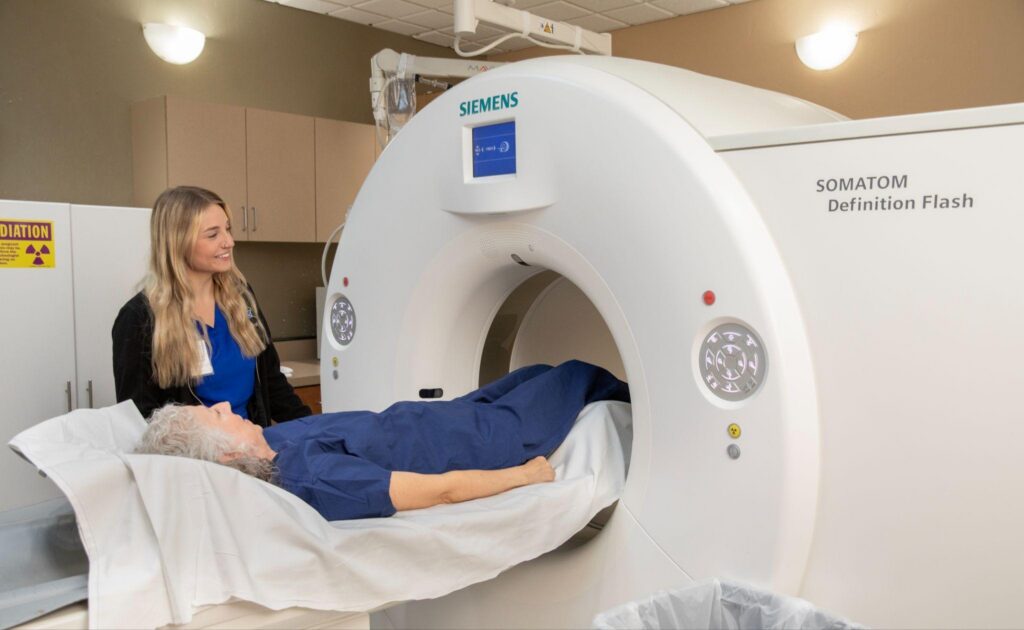
- Body placement. Throughout your exam, you lie on a table that slides into the donut-shaped CT scanner. Your care team will position you on the table so that the scanner gets good images of your abdomen.
- Imaging. The CT scanner rotates around you. As it does, X-ray beams capture images of your abdomen from multiple angles. These images are called slices and can be combined into three-dimensional images. For the clearest images, you may need to hold your breath for short periods while the machine takes photos.
- Discharge. You return home immediately after your CT scan and resume your normal routine. If you receive contrast via IV, an imaging technologist removes the IV and encourages you to drink lots of water during the remainder of the day.
Typically, CT scans are quicker than magnetic resonance imaging (MRI) exams.
From start to finish, most abdominal CT appointments last about half an hour, with approximately 2-5 minutes spent in the scanner.
What Radiologists and Other Providers Do With the Results
Following your exam, a board-certified radiologist at Radiology Ltd. reviews your images for abnormalities. The radiologist then reports these findings to your referring provider, who shares the findings with you.
Depending on the results of your abdominal CT scan, your provider may do one or more of the following:
- Diagnose your condition
- Develop a tailored treatment plan that fits your needs
- Order additional testing
Radiology Ltd.: Your Choice for Abdominal CT Scans
At Radiology Ltd., our skilled radiology team works hard to get you in and out of your abdominal CT scan as quickly as possible.
With same or next-day appointments, we make it simple to access quality CT scans in the Tucson area. Radiology Ltd. has 7 convenient locations in Tucson, 2 in Green Valley and 1 in Oro Valley.
Abdominal CT Scans: Fast Facts
An abdominal CT scan is a vital tool in detecting, diagnosing, and managing issues affecting the pancreas, kidneys and other abdominal organs.
Symptoms such as abdominal pain and bloody urine may indicate conditions ranging from hernias to cancer. An abdominal CT can help rule out and confirm the presence of these conditions and others.
Most abdominal CT scans take approximately 2-5 minutes and provide detailed information that your referring provider uses to make informed care decisions.
Did your provider order an abdominal CT scan for you? Call (520) 733-7226 or request an appointment online to schedule your scan at Radiology Ltd.