
How Long Does an MRI Take and What Goes on During the Exam?
A magnetic resonance imaging (MRI) scan helps your care team detect, diagnose, and monitor disease progression. It’s particularly useful when your health condition affects soft tissues, such as the heart, brain or abdomen. How long does an MRI take? That depends.
An MRI normally takes between 30 and 60 minutes. However, your scan may require more or less time. Here’s why.
Understanding How MRI Works
To learn how long an MRI takes, it helps to know how it works. Some imaging technologies, such as X-ray and computed tomography (CT) scans, use radiation. MRI does not.
Instead, this scan uses strong magnets and radio waves to affect protons, positively charged particles in your body that contain tiny magnets. During your exam, the following occurs:
- The machine points a powerful magnet at your body. This strong magnetic field forces your body’s protons to move and point in the same direction.
- The machine then sends a pulse of radio waves through your body. When this happens, the protons fall out of alignment.
- As soon as the pulse of radio waves disappears, the protons return to their aligned position, and the MRI captures an image. Members of your care team review these images to identify potential health issues.
MRIs capture more detailed images of soft tissues and joints than other technologies and help find and assess many conditions, including the following:
- Joint injuries
- Tumors
- Spine injuries
- Vascular disease
Why Your MRI May Take Longer
While an MRI exam typically lasts no more than an hour, several factors affect how long your MRI takes. The length of your scan depends on the following:
- Body part being scanned. How long your MRI takes varies based on the body part undergoing examination. For example, scanning your spine typically takes less time than a brain scan, but not always.
- MRI scanner. Newer technology captures quality images in less time than older scanners. New advances, like the 3T wide-bore MRI at Radiology Ltd., also make imaging more comfortable for you.
- Repeat scans. If the MRI machine doesn’t get high-quality, clear images the first time, your care team will repeat the scan. This ensures they have the information they need to provide quality care.
- Use of contrast or sedation. A special contrast material given through an IV helps improve clarity when imaging specific areas. Getting the IV set up and injecting contrast adds time to your test. Also, if you have anxiety or difficulty staying still, you may take sedating medicine to help you relax. Sedating medication can cause your exam to take twice as long.
How You Can Make Your MRI Experience as Quick as Possible
When visiting Radiology Ltd., your MRI will take less time if you follow your imaging team’s instructions. Prior to your exam, they may ask you to do the following:
- Avoid food and drink. For some scans, such as an abdominal MRI, you need to fast for four to eight hours beforehand. A member of your care team will clearly explain whether you should avoid food or drink.
- Leave jewelry at home. Because MRI relies on a strong magnet, you should not bring jewelry or other metal objects to your appointment. If you have artificial joints or other implanted materials in your body, discuss this with your team. Also, wear comfortable clothing you can take off with ease. This makes it easier if you need to change into a hospital gown for your exam.
- Show up on time. For exams without sedatives, you only need to show up 15 minutes early. If you plan to take a sedative, arrive at your Radiology Ltd. location an hour before your scheduled MRI.
- Take sedating medication as prescribed. If taking sedatives for your MRI, bring the medication to your appointment and arrange for someone to take you home after your exam. Your imaging technologist will tell you when to take the medication.
What Your MRI Experience Includes
Once you check in, you get taken to an imaging suite. There, your care team prepares you for your exam. Depending on the type of MRI and your symptoms and medical history, the following takes place:
- If appropriate, a medical expert injects contrast material into a vein through an IV. This material enhances imaging accuracy in certain situations. According to the National Institutes of Health, as many as 45% of all MRIs in the U.S. involve contrast.
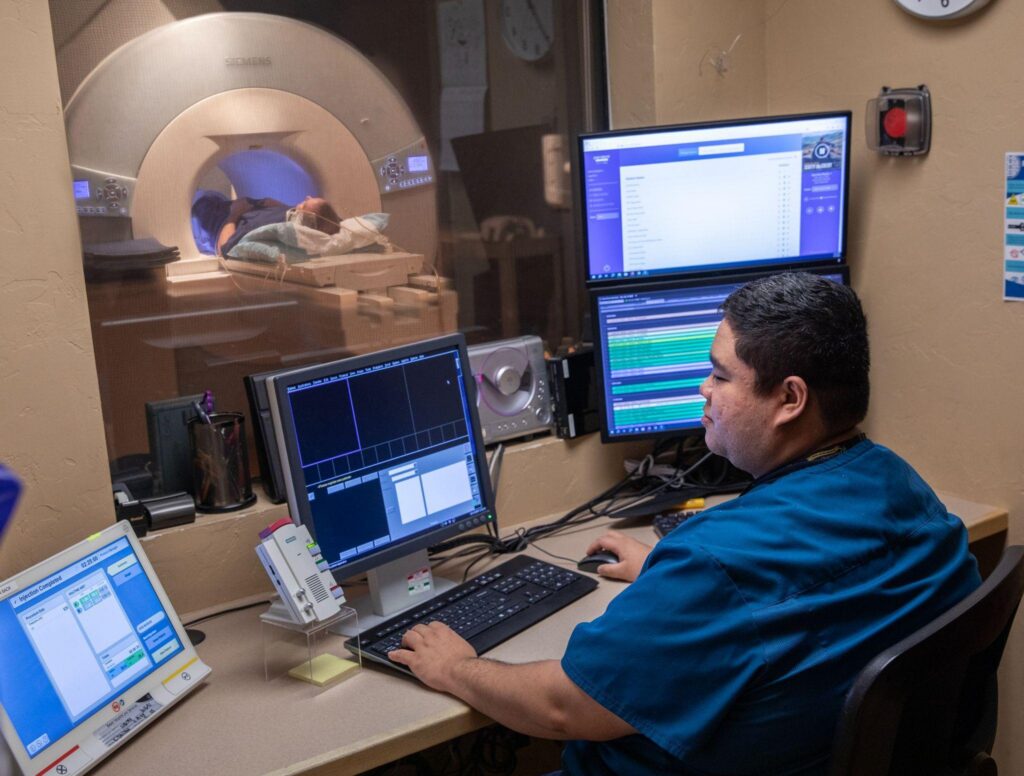
- You lie on a table. The table slides into a donut-shaped machine that contains the large magnet.
- The MRI machine works to capture images of your insides. While totally painless, your exam can be noisy. A Radiology Ltd. staff member provides earplugs or headphones to reduce the noise level.
How Long Does Recovery After an MRI Take?
If you receive sedatives, it can take a little time to feel like yourself again. Otherwise, there is usually no recovery from an MRI scan. As soon as your scan is finished, you can return to your normal daily activities.
Soon after your exam, a Radiology Ltd. radiologist sends the results to your referring provider. Based on the results, your provider may order additional tests, such as a biopsy or bloodwork. These help determine a definitive diagnosis.
MRI Length: Times May Vary
How long an MRI will take varies based on several factors. Understanding these helps you know how much time to allot for your exam.
MRIs use strong magnets and radio waves to produce high-quality images of soft tissue. These help detect, diagnose, and monitor tumors, diseases, and injuries.
The average MRI takes 30 to 60 minutes. Yours may take more or less time based on technology used, body part scanned, and other factors.
During your exam, you lie on a table as the MRI captures images. There is normally no recovery time from the exam, which provides valuable information on your health.
Did your provider order an MRI for you? Call (520) 733-7226 or request an appointment online with the caring professionals at Radiology Ltd.