
How Much Radiation Is in a CT Scan and Should You Worry?
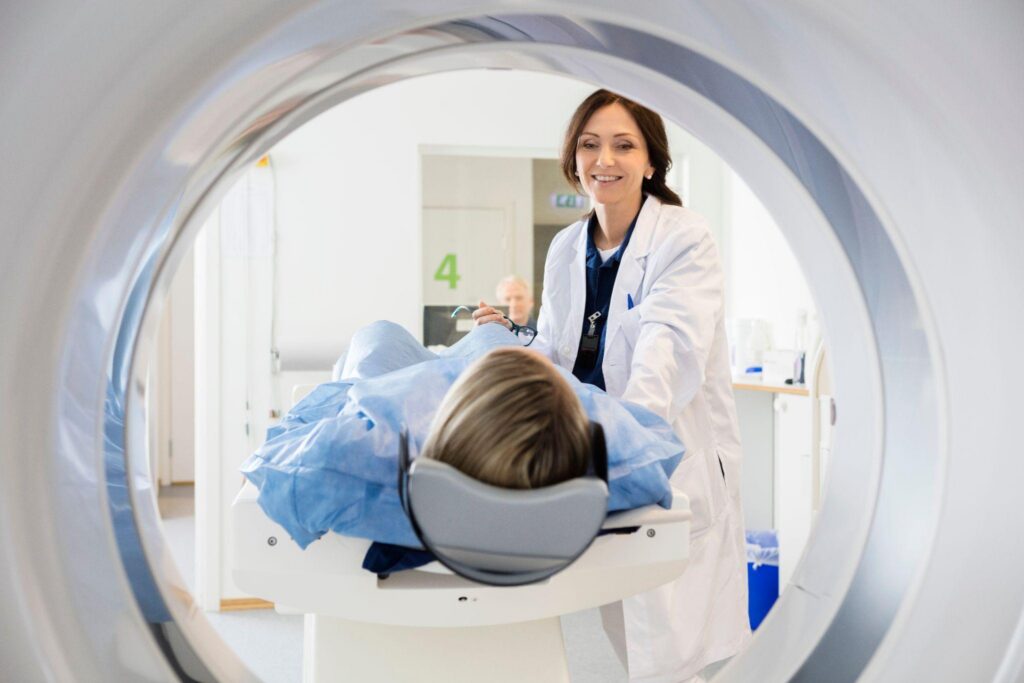
Computed Tomography (CT) scans use radiation to produce a clear image of the inside of your body. As a result, you experience a certain amount of radiation exposure during a CT test. How much radiation is in a CT scan?
Continue reading to discover the answer to that important question, along with responses to other frequently asked questions.
Why Does CT Use Radiation?
According to the United States Environmental Protection Agency , you get exposed to radiation every day. It comes from soil, water, your body and even outer space.
Known as background radiation, this radiation comes from natural sources and rarely causes health issues. Imaging procedures, such as CT scans, rely on a specific type of radiation called ionizing radiation.
Ionizing radiation is high-energy radiation that helps create CT images through the following process:
- The CT scanner rotates around you, sending beams of radiation through your body.
- This radiation passes through bones, internal organs and other tissues.
- As it passes through you, the radiation interacts with various tissue types, producing images that help evaluate specific parts of the body.
Without radiation, a CT scanner would not be able to show what’s going on under your skin. Therefore, it plays a crucial role in medical imaging, helping to diagnose, plan treatment and monitor disease progression.
What Are Radiation Risks?
Though you’re exposed to radiation every day, too much can be dangerous. High doses of radiation can damage your DNA and change the structure of your cells. When this happens, your risk increases for cancer and other unwanted health issues.
If you’re exposed to lots of radiation in a short amount of time, you may vomit, feel nauseous and have other symptoms.
How Much Radiation Is in a CT Scan?
Radiation absorbed by your body is measured in millisieverts (mSv). The Centers for Disease Control and Prevention report that a typical CT scan exposes you to approximately 10 millisieverts (mSv).
This is more than a digital X-ray, but the increased radiation is necessary to create images of higher quality.
A few common sources of radiation include:
- Chest X-ray: 0.1 mSv
- Dental X-ray: 0.005 mSv
- Typical CT scan: 10 mSv
The average American absorbs 6.2 mSv per year. Radiation absorption of 500 mSv can harm your blood cells, and a single dose of 10,000 mSv results in death.
Improving the Safety of Your CT Scan
Less radiation exposure is always better, and every CT exposes you to a little bit of radiation. Therefore, it’s best to avoid unnecessary CT scans to reduce your risk of long-term complications that may occur from radiation exposure.
Three people can help limit how much radiation exposure you receive from CT scans.
- You. A CT scan may be a required step in your care journey, but it is not always necessary. Whenever your healthcare provider refers you for a CT scan, ask if the exam is necessary. In some cases, an ultrasound or MRI can be useful.
- Your referring provider. Several factors determine whether you need a CT scan, and your provider considers them all. The appropriate exam depends on the body part being examined, the urgency of the exam and other factors.
- Your imaging facility. High-quality imaging facilities take care to protect you against excess radiation exposure. At Radiology Ltd., our expert technologists combine their experience with advanced technology to minimize the effective dose of radiation while still achieving clear images.
The Bottom Line Regarding CT Scans and Radiation
Whether you require a single or multiple CT scans over the years, take heart. The benefits of your scan outweigh any risk.
With minimal radiation exposure, your care team can detect and manage many life-threatening conditions, including:
- Blood clots
- Cancer and noncancerous tumors
- Head trauma
- Hemorrhages
- Joint degeneration
- Pneumonia
Once diagnosed, you can work with your care team to develop a treatment plan that helps slow down or correct your problem before it worsens.
Making Informed Decisions About Your CT Scan
If your provider prescribes a CT scan, understanding how much radiation is in a CT scan helps you feel confident as you take the next step in your health journey.
CT scanners use ionizing radiation. As it passes through your body, it interacts with various types of tissue to produce clear images that are useful for diagnosis, treatment planning and disease monitoring.
Though a typical CT scan exposes you to more radiation than an X-ray, the benefits of a CT scan outweigh any potential risks.
Work with your referring provider and imaging facility to minimize your radiation exposure when undergoing a CT scan.
Did your provider order a CT scan for you? Call (520) 733-7226 or request an appointment online with the experts at Radiology Ltd., for a seamless experience with minimal radiation exposure.